
Trip Info
- Tea House & Tented Camp
- Included (Guide & Staff)
- Trekking & Climbing Permits Included
- 6,091
- Kathmandu
- Spring & Autumn
- Kathmandu
- Professional Climbing Guide
- Airport Pickup & Drop Included
- 30 Days Before Start
Singu Chuli Peak Climbing - 18 Days
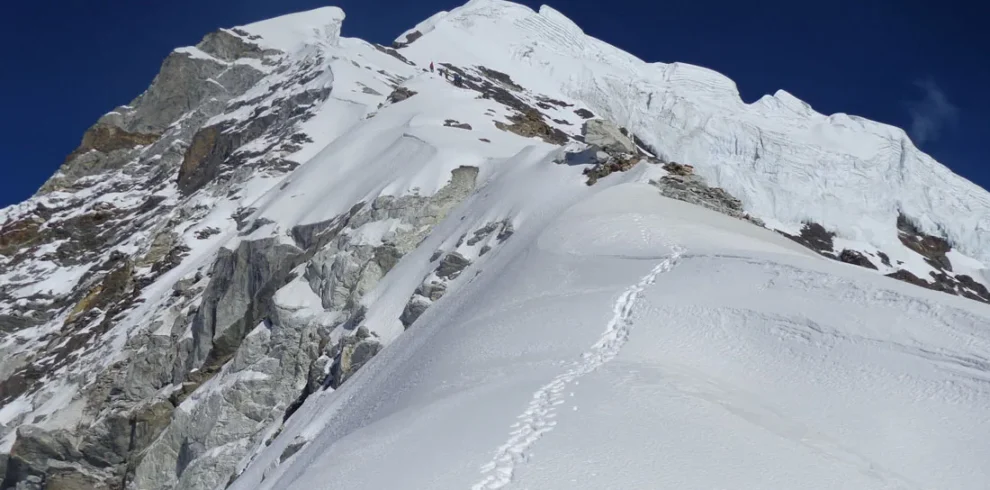
Singu Chuli stands as one of Nepal’s most technical trekking peaks, rising sharply above the Annapurna Sanctuary with its distinctive fluted ridges cutting through the sky. The expedition combines the scenic beauty of the Annapurna region with genuine alpine climbing challenges that require rope skills, ice axe proficiency, and steady nerves on exposed sections. This journey offers climbers a chance to test themselves on a serious Himalayan summit while experiencing the cultural richness of Gurung villages and rhododendron forests that blanket the lower valleys.
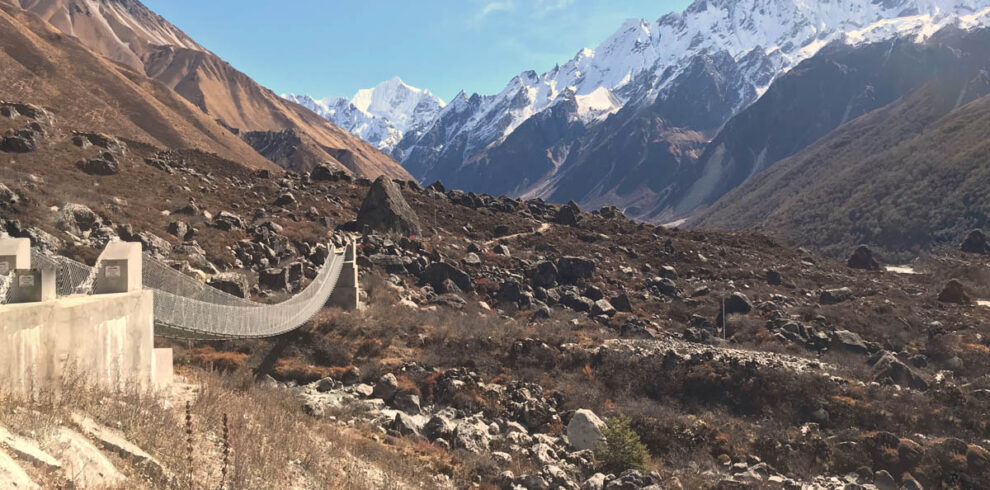
The route follows the classic Annapurna Base Camp trail before branching toward the isolated high camps beneath Singu Chuli’s south face. You will cross suspension bridges over the roaring Modi Khola, walk through bamboo groves where sunlight filters in scattered beams, and eventually reach the glacier-carved amphitheatre where massive peaks encircle you on all sides. The final summit push involves steep snow slopes, technical ridge climbing, and careful navigation through crevassed sections that demand full concentration.
Nepal Holiday Treks designs this expedition for climbers who have moved beyond basic trekking and want to engage with real mountaineering challenges in a controlled environment. The itinerary builds in adequate acclimatization rest days, employs experienced Sherpa guides who fix ropes on technical sections, and maintains support systems that prioritize safety without diminishing the authentic mountain experience. Success depends on weather windows, physical conditioning, and the ability to make sound decisions when conditions shift unexpectedly.
Trip Highlights
- Annapurna Base Camp trail
- Highest trekking peak in Nepal
- Everest or Annapurna, Ramdung
- Remote and less crowded trekking route
- Gradual acclimatization for safety
- Climbing training included
- Glacier walking experience
- Cultural experience in traditional Himalayan villages
Itinerary
The moment you step out of Tribhuvan International Airport, the chaotic energy of Kathmandu engulfs you with honking taxis, street vendors, and the faint scent of incense drifting from nearby temples. Your guide meets you at arrivals and transfers you to your hotel in Thamel, where narrow alleys buzz with gear shops, restaurants serving momos, and travelers comparing route maps. After checking in, you have time to rest or explore the neighborhood’s labyrinth of streets packed with colorful prayer flags and handcrafted souvenirs. The evening brings a team briefing where your climbing leader explains the expedition timeline, equipment requirements, and what to expect in the days ahead. You will submit passport copies for permits, confirm your gear list, and ask any lingering questions about the route. This first night in Kathmandu often feels surreal as jet lag mixes with anticipation for the challenges waiting in the mountains.
Morning light reveals Kathmandu’s ancient heritage as you visit Swayambhunath, the hilltop stupa where resident monkeys scramble across stone pathways and prayer wheels spin in constant motion. The all-seeing eyes of Buddha painted on the golden spire watch over the valley while pilgrims circumambulate the base, murmuring mantras and lighting butter lamps in small alcoves. You then move to Pashupatinath Temple on the Bagmati River, where cremation ceremonies unfold on the ghats and sadhus with ash-smeared faces sit in meditation beneath ancient trees. The contrast between life and death, sacred and mundane, plays out in vivid detail along the riverbanks. While you explore these UNESCO World Heritage sites, your guide handles the bureaucratic work of securing climbing permits and coordinating with local authorities. The afternoon includes a final gear check where you verify that your crampons fit your boots properly, your harness adjusts correctly, and your down suit provides adequate warmth for high-altitude conditions.
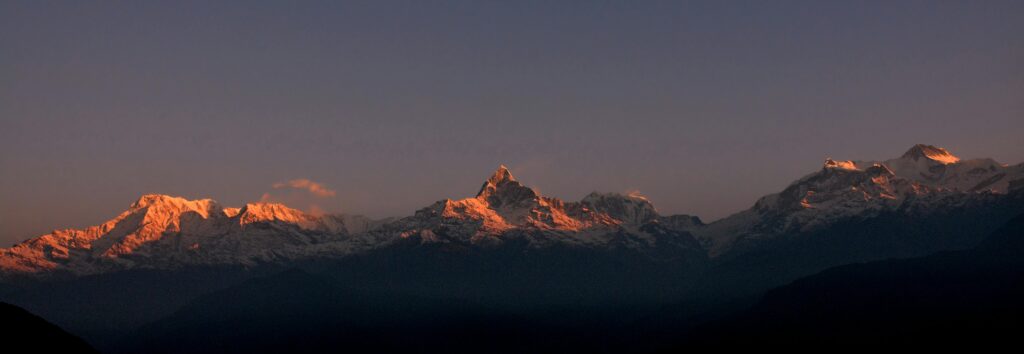
The highway west unrolls through terraced hillsides where farmers guide water buffalo along muddy paths and children wave from schoolyard courtyards as your bus rumbles past. The Trishuli River parallels the road for long stretches, its milky glacial water churning over boulders and cutting deep gorges through the landscape. Roadside stops reveal local life in small towns where tea shops serve sweet milk tea in glass cups and vendors sell fresh oranges piled in woven baskets. As you descend toward the Pokhara valley, Machhapuchhre’s fishtail summit appears on the horizon like a stone cathedral rising above the foothills. The lakeside city spreads along Phewa Tal, where traditional wooden boats float near the shore and paragliders spiral down from Sarangkot’s launch point in colorful arcs. Evening in Pokhara feels relaxed compared to Kathmandu’s intensity, with lakeside restaurants offering views of the Annapurna range glowing pink in the sunset.
The drive from Pokhara to Nayapul follows the Seti River valley through villages where houses cluster on terraced fields and banana trees shade small gardens. At the trailhead, porters organize loads while your guide distributes trekking permits and confirms the day’s plan. The initial trail descends to the Modi Khola, crosses a substantial suspension bridge that sways gently underfoot, then climbs steadily through stone-stepped villages where locals sell fresh apples and homemade rakshi. You pass Birethanti where trekking permits get stamped at a checkpoint, then continue alongside the Bhurungdi Khola through forests of oak and rhododendron. Tikhedhunga appears as a small cluster of lodges built into the hillside, with rushing water from the nearby stream providing a constant background roar. The evening brings your first taste of dal bhat in a teahouse dining room where trekkers from various routes share tables and swap stories about trail conditions.
The infamous stone staircase from Tikhedhunga climbs relentlessly through Ulleri village, testing your legs early in the expedition as sweat soaks through your base layers despite the cool morning air. Local women carrying enormous loads of firewood or vegetables in traditional doko baskets pass you on the steps, their breathing steady and efficient while yours comes in labored gasps. Beyond Ulleri the trail levels into gentler climbing through rhododendron forests where moss hangs from twisted branches and filtered sunlight creates dappled patterns on the forest floor. You cross streams on small wooden bridges, pass mani walls carved with Buddhist prayers, and occasionally glimpse snowy peaks through gaps in the canopy. Ghorepani sits on a broad ridgeline where lodges cluster around a central area and prayer flags stretch between buildings in colorful tangles. The village name translates to “horse water,” recalling its history as a rest stop for traders moving livestock between valleys. As darkness falls, you can see lights from Tatopani village far below in the gorge and the black silhouette of Dhaulagiri rising to the west.
Predawn cold bites through your down jacket as you climb the stone steps to Poon Hill viewpoint, joining a crowd of trekkers and photographers staking out positions for sunrise. The first light touches Dhaulagiri’s summit pyramid, then spreads across the Annapurna massif in a wave of orange and gold that seems to set the peaks ablaze against the deep blue sky. You stand watching as the entire panorama reveals itself, from Nilgiri to Annapurna South to Machhapuchhre, each summit catching the light in turn while the valleys below remain in shadow. After the spectacle ends and the crowds disperse, you descend to Ghorepani for breakfast before setting off toward Tadapani through deep forests of rhododendron and oak. The trail undulates along the ridgeline, occasionally opening to views before plunging back into the forest where bird calls echo through the trees and red pandas hide in the upper branches. Tadapani’s lodges sit in a clearing surrounded by forest, with Annapurna South and Machhapuchhre dominating the eastern skyline.
The descent from Tadapani drops steeply through rhododendron forests before reaching the Kimrong Khola gorge, where you cross a suspension bridge and immediately begin the exhausting climb up the opposite side. Your thighs burn on the stone steps leading to Chhomrong village, which sprawls across terraced hillsides with traditional stone houses featuring slate roofs and small vegetable gardens. This Gurung settlement serves as the last major village before entering the Annapurna Sanctuary, with well-stocked lodges, bakeries selling cinnamon rolls, and shops offering last-minute trekking supplies. Children play in the narrow alleys between houses while their parents work in nearby fields or tend to livestock in stone-walled enclosures. From the village’s upper terraces, Annapurna South rises directly ahead like a massive wall of ice and rock, its hanging glaciers catching the afternoon light. Evening conversations in the lodge dining room reveal the mix of trekkers heading to base camp and those returning with summit stories and weather reports from higher elevations.
The trail descends sharply from Chhomrong through cultivated terraces before reaching the Chhomrong Khola, where another suspension bridge marks the entry into wilder terrain. Beyond this point, the valley narrows and the forest changes character, with bamboo groves replacing the oak and rhododendron of lower elevations. The Modi Khola rushes through a deep gorge to your left, its roar constant and powerful as glacial meltwater crashes over boulders and fallen trees. You pass through Bamboo village, little more than a few lodges built into the steep hillside where avalanche danger from the slopes above requires careful site selection. The trail continues through what locals call the “avalanche zone,” where massive swaths of forest have been flattened by slides and caution signs remind trekkers not to linger. The narrowing valley creates a cathedral-like atmosphere, with vertical walls rising on both sides and only a thin strip of sky visible above.
Morning brings cold air draining down from the glaciers above as you continue ascending through forests that grow progressively more stunted and twisted. The bamboo gives way to scrubby vegetation clinging to rocky slopes, and the valley widens slightly as you approach Himalaya Hotel, a small lodge built into a stone outcrop where trekkers stop for tea and shelter from occasional rockfall. Beyond this point, the landscape takes on an increasingly alpine character with fewer trees and more exposed rock faces streaked with mineral deposits and ice. You pass through the “Hinku Cave” area where overhanging cliffs provide some protection from weather, then emerge into more open terrain as the valley curves toward the sanctuary entrance. Deurali sits on a rocky shelf where the forest finally surrenders to the high-altitude environment, with stunted junipers and hardy alpine plants the only vegetation clinging to the slopes. Weather patterns shift rapidly here, with clouds forming in the valley below and swirling around the peaks above in a constant atmospheric dance.
The final approach to the sanctuary crosses moraines left by retreating glaciers, with massive boulders scattered across the valley floor like dice thrown by giants. As you climb higher, the amphitheater begins to reveal itself with Annapurna South’s north face rising directly ahead and Hiunchuli’s sharp summit appearing to the west. The trail passes Machhapuchhre Base Camp, where some trekkers choose to stop, but you continue another two hours to reach the inner sanctuary. Crossing the final moraine brings you to Annapurna Base Camp, a collection of lodges built on glacial debris with peaks encircling you in a 360-degree panorama of rock, ice, and sky. Annapurna I dominates the northern skyline at close range, its massive south face and hanging glaciers appearing close enough to touch despite the actual distance. You spend the afternoon walking around the base camp area, studying the surrounding peaks and identifying your objective, Singu Chuli, which rises to the east with its distinctive fluted ridges clearly visible.
This rest day allows your body to adjust to the thin air while your climbing Sherpa scouts the approach route to Singu Chuli Base Camp and checks snow conditions on the lower slopes. You wake to sunrise illuminating the south face of Annapurna I, watching as light creeps down the massive wall and eventually reaches the base camp area. The morning passes slowly with short walks around the moraine, practicing crampon technique on nearby snow patches, and reviewing rope systems with your guide. Afternoon clouds typically roll into the sanctuary, obscuring the peaks and sometimes bringing light snow that dusts the rocks white before melting away. Other climbers in camp share information about route conditions, summit attempts, and weather forecasts from their satellite communicators. The evening brings clear skies again as stars appear overhead in astonishing density, unobscured by light pollution or atmospheric haze.
The route to Singu Chuli Base Camp branches east from Annapurna Base Camp, following moraine ridges and glacier edges toward the peak’s south approach. Your Sherpa team carries technical climbing equipment including ropes, ice screws, snow stakes, and group gear that will be used higher on the mountain. The terrain grows increasingly rocky and unstable, requiring careful foot placement on loose scree and careful navigation around crevasses appearing in the glacier. You traverse across lateral moraines where rockfall risk from the surrounding peaks demands constant awareness and quick reactions to falling debris. Base camp sits on a relatively flat section of moraine at the foot of Singu Chuli’s south face, with limited tent platforms requiring careful site selection to avoid hazards. The climbing Sherpa establishes camp while you rest and hydrate, watching the afternoon sun illuminate the fluted ridges above and trying to identify the route you will follow toward the summit.
Morning brings a team meeting where your guide explains the summit day plan, rope team formations, and turnaround times based on weather forecasts. You spend time organizing personal climbing equipment, checking that your ascender and belay device function properly, and packing a light summit bag with essential items only. The climbing Sherpa makes a carry to high camp, depositing tents, fuel, and fixed ropes at the advanced position while you conduct a short acclimatization climb on the lower slopes. You practice front-pointing on steep snow, reviewing ice axe self-arrest techniques, and moving efficiently while roped together with your climbing partners. The afternoon brings rest in base camp tents where you force down fluids despite altitude-suppressed appetite and try to sleep despite the nervous energy building before summit day. Weather conditions receive constant monitoring through satellite weather services and visual assessment of cloud patterns forming around nearby peaks.
The route to high camp follows the lower southwest ridge, gaining elevation steadily over broken rock and snow-covered slopes that require both scrambling and moderate climbing skills. Your Sherpa team has fixed ropes on the steepest sections where exposure increases and consequences of a fall become serious. You clip into the fixed lines with your ascender, moving methodically upward while managing your breathing and maintaining focus on each individual move. The terrain alternates between snow slopes requiring crampons and rocky sections where you scramble on your hands and knees over loose terrain. High camp occupies a small platform hacked into the snow at the base of the summit pyramid, with barely enough space for two tents and a cooking area. Arriving at high camp in early afternoon gives you time to hydrate, eat a hot meal, and try to rest before the pre-dawn summit attempt. The sunset view from this elevation reveals the entire Annapurna range spread before you, with shadows lengthening across the glaciers far below.
Darkness surrounds you completely at 1 AM when the alarm sounds and you begin the mechanical process of preparing for the summit push. Hot tea and simple food force down reluctant throats before you gear up with harness, crampons, helmet, and headlamp, then rope up with your Sherpa and begin climbing by the narrow beam of LED light. The route ascends steep snow slopes where your headlamp beam reveals only the immediate few meters ahead while the vast darkness presses in from all sides. Dawn catches you on the exposed upper ridge where the fluted formations create technical challenges requiring careful route-finding and delicate moves on rotten rock mixed with ice. The final summit ridge narrows dramatically with exposure dropping away on both sides, demanding absolute focus as you front-point up the last steep snow before reaching the small summit platform. Standing on top, you have only moments to absorb the 360-degree panorama of Himalayan giants before the guide urges you to descend while weather conditions remain favorable. The return to high camp passes in a blur of concentration, then continues down fixed ropes to base camp where you collapse in tents, exhausted but successful.
This contingency day provides flexibility for weather delays or allows for a more gradual descent if the team feels exhausted from the summit push. If summit day went smoothly and weather remains stable, you break camp and descend to Annapurna Base Camp, retracing your steps across moraines and glacier edges with significantly lighter packs now that technical equipment has been used. The return journey feels almost effortless compared to the upward struggle, though caution remains essential on loose terrain where fatigue increases injury risk. Back at Annapurna Base Camp, you celebrate the successful ascent with other trekkers and climbing teams, sharing photos and comparing experiences over hot meals in the dining lodges. The surrounding peaks that seemed impossibly huge days ago now feel familiar, almost like old friends watching over your achievement.
The descent from Annapurna Base Camp follows your ascent route in reverse, but the perspective changes completely when traveling downhill through landscapes you previously climbed. Your legs work differently on the descent as you brake against gravity, feeling the impact in knees and ankles as you lose elevation rapidly. The sanctuary narrows again as you pass Machhapuchhre Base Camp and Deurali, entering the forested sections where the temperature rises noticeably and vegetation becomes progressively more lush. By the time you reach Bamboo, the thin alpine air of the sanctuary feels like a distant memory as thicker atmosphere allows deeper breathing and better sleep. The lodge dining room buzzes with trekkers at various stages of their journeys, some heading up with nervous excitement and others returning with satisfying exhaustion.
The final trekking day begins with a steep climb out of the bamboo forest zone to reach Chhomrong, where you stop for tea and a final view of Annapurna South from the village terraces. The trail then descends aggressively through stone steps and switchbacks, crossing the Chhomrong Khola before the exhausting climb to Kimrong and subsequent descent to the Modi Khola valley. Your knees protest the constant downhill pounding, but the end point at Nayapul grows steadily closer as you pass through increasingly developed villages with motor roads and electricity. Reaching Nayapul brings a mix of relief and nostalgia as you load into vehicles for the drive back to Pokhara, watching the mountains recede in the distance through dusty bus windows. That evening in Pokhara, Nepal Holiday Treks organizes a celebration dinner where you toast the successful expedition and reflect on the journey from nervous anticipation to summit achievement. The lakeside restaurants and comfortable hotels feel luxurious after weeks in mountain lodges, with hot showers and cold beer marking the transition back to civilization.
Includes/Excludes
Cost Includes
- Airport pickup & drop
- Professional climbing guide
- climbing permit
- Trekking permits
- Accommodation during the trek
- Tented camp at Base Camp
- All meals during the trek
- Climbing training
- Safety equipment
- First aid support
- Support staff
Cost Excludes
- International airfare
- Personal climbing gear
- Travel insurance
- Personal expenses
- Tips for guide & porter
- Extra accommodation
- Emergency rescue
FAQs
Solid trekking fitness plus basic mountaineering skills like crampon use, ice axe control, and rope travel. Prior glacier experience or a mountaineering course is highly beneficial.
Late September to November and March to May offer the most stable conditions. Autumn gives clear views, while spring feels slightly warmer with softer snow.
Yes, for personal gear such as harness, helmet, boots, and ice axe. Group equipment is usually provided, but always confirm the list.
It is more technical than beginner peaks, with steep snow, exposed ridges, and complex route sections. Best for climbers with prior experience.
A buffer day allows flexibility, but unsafe conditions mean the climb is stopped. Safety always takes priority over the summit.