

Trip Info
- Tea House & Tented Camp
- Included (Guide & Staff)
- Trekking & Climbing Permits Included
- 6,440 meters
- Kathmandu
- Spring & Autumn
- Kathmandu
- Professional Climbing Guide
- Airport Pickup & Drop Included
- 30 Days Before Start
Mt. Cholatse 20 Days
Cholatse rises to 6,440 meters above the Khumbu Valley as one of Nepal’s most visually striking technical peaks, its sharp pyramid silhouette visible from Gokyo and the surrounding ridgelines. This is not a trekking peak where a fit hiker can improvise their way to the top. The climb demands real technical skills on mixed ice and rock terrain, and the route above high camp tests both physical endurance and your ability to move confidently on steep glaciated ground.
The approach through the Khumbu and Gokyo valley adds genuine depth to this expedition. You walk past turquoise glacial lakes, cross the dramatic Cho La Pass, and spend days in high alpine terrain before even setting foot on the mountain. By the time you reach base camp, the landscape has already delivered more than most treks in Nepal ever do.
Nepal Holiday Treks has organised this itinerary to give climbers the acclimatisation time, technical preparation, and rest days needed to attempt the summit with a realistic chance of success. The 20-day schedule is intentionally paced so that altitude gain is gradual and the technical sections above high camp are never rushed.
Trip Highlights
- Khumbu Valley,Gokyo
- Highest trekking peak in Nepal
- Everest or Annapurna, Ramdung
- Remote and less crowded trekking route
- Gradual acclimatization for safety
- Climbing training included
- Glacier walking experience
- Cultural experience in traditional Himalayan villages
Itinerary
You land at Tribhuvan International Airport and transfer to your hotel in Thamel, the lively tourist district packed with gear shops, bakeries, and narrow streets worth wandering through in the evening. Your guide will meet you at the hotel for a short welcome briefing covering the schedule, gear checklist, and any last-minute logistics. It’s worth spending the evening doing a final review of your climbing equipment since this is your last reliable chance to source anything missing before the expedition begins. The city itself sits in a wide valley ringed by green hills, and on a clear evening, distant Himalayan summits are sometimes visible from rooftop restaurants.
The morning starts with a visit to the Nepal Mountaineering Association office to collect your climbing permit for Cholatse, followed by a gear check with your climbing guide. Your guide will walk through how to use technical equipment including crampons, ascenders, and ice axes if any team members need a refresher before reaching the mountain. In the afternoon, the team typically visits Boudhanath Stupa, one of the largest Buddhist stupas in Asia, where butter lamps burn around the base and the circular prayer path stays busy from morning until late evening. This day serves as both a logistical reset and a chance to mentally settle into the expedition.
The early morning flight from Kathmandu to Lukla is one of the most talked-about short flights in the world, with the aircraft descending steeply toward a sloped runway carved into the mountainside at Tenzing-Hillary Airport. From Lukla, the trail drops through pine and rhododendron forest along the Dudh Koshi River, passing small Sherpa villages with prayer flags strung between houses and mani stones lining the path. Phakding itself is a quiet village where the river runs loudly past teahouses and the first real views of the upper Khumbu peaks start to appear between the valley walls. This is a relatively easy walking day designed to get your legs moving before the gradient increases.
The trail from Phakding to Namche crosses several suspension bridges draped in prayer flags, swinging above the Dudh Koshi gorge with the river churning far below. The final climb to Namche is a long, relentless switchback ascent through forest where you might encounter yak trains coming down with loads from upper villages. Just before you crest the ridge into Namche, a gap in the trees opens to reveal Everest, Lhotse, and Nuptse lined up together in a way that stops most trekkers cold. Namche itself is a horseshoe-shaped town built into a natural bowl in the hillside, with a bustling weekend market, a good bakery, and plenty of teahouses to recover in before the next day.
Rest days at altitude are not passive. The recommended approach is to hike up to the Everest View Hotel ridge at around 3,880 meters, which gives you a panoramic sightline to Everest, Ama Dablam, Thamserku, and Kongde, then return to Namche for the night. The ascent pushes your body to adapt at a higher elevation while the descent back ensures you sleep lower, which is the core principle of effective acclimatization. You can also visit the Sherpa Culture Museum in town, which provides good context for the history and traditions of the communities you’ll be walking through for the next two weeks. Namche has reliable enough internet and cafes to sort any loose ends before the valley gets more remote.
Leaving Namche, the trail climbs steeply out of the bowl and onto a broad ridge that runs above the Bhote Koshi valley, with sweeping views across to Khumbila and the ridgeline separating you from the Everest Base Camp route. The path passes through Mong La and Phortse Tenga before ascending sharply again to Dole, a small cluster of stone teahouses sitting on an open hillside. At this point the vegetation has thinned considerably; juniper scrub replaces the dense pine forest of lower elevations, and the sky feels bigger and sharper. Dole is where many trekkers notice altitude effects for the first time, particularly reduced appetite and lighter sleep, so eating well and drinking water throughout the day matters more than it did below.
This stretch of trail continues up the Dudh Koshi valley through increasingly open terrain, passing the small settlement of Luza before arriving at Machhermo, which sits on a wide shelf above the valley floor with excellent views toward Cho Oyu. The walking itself is not technically difficult, but the reduced oxygen at this elevation means that what would be an easy pace at lower altitude requires noticeably more effort. Machhermo has a small ranger station and a conservation area office, and the surrounding hillsides are frequented by Himalayan tahr, a wild mountain ungulate often spotted in the mornings on the grassy slopes. Staying well-rested here prepares you for the longer walking day ahead to Gokyo.
The trail from Machhermo follows the valley upward past Pangka before the landscape shifts dramatically as you approach the edge of the Ngozumpa Glacier, the longest glacier in Nepal, a vast grey and white expanse of moraine and ice that stretches several kilometers in both directions. The first of the Gokyo lakes appears shortly before the village, its water an electric turquoise against the grey rock and white peaks, a color so vivid it looks almost artificial. Gokyo village itself is a small set of teahouses and lodges huddled at the lakeside with unobstructed views of Cho Oyu, the sixth-highest mountain in the world, and the jagged outline of Cholatse visible to the southeast. This is the moment most climbers get their first direct look at the mountain they came to climb.
Gokyo Ri is the rounded peak directly above the village and the acclimatization hike of choice in this valley. The climb takes about two hours from the village and the summit at 5,357 meters delivers arguably the finest panoramic view in the entire Khumbu region, with Everest, Lhotse, Makalu, Cho Oyu, and the full arc of the Ngozumpa Glacier laid out in every direction. The descent brings you back to the village by mid-morning, leaving the rest of the day for rest, equipment checks, and gear organization before crossing the Cho La Pass the following day. Nepal Holiday Treks guides typically use this afternoon to walk climbers through the technical gear setup and glacier travel techniques that will be needed on Cholatse.
The Cho La Pass is a genuine mountain crossing, not a tourist trail, and the approach starts early to ensure you reach the technical section of the pass before conditions deteriorate in the afternoon. The trail from Gokyo passes through Dragnag before ascending sharply over moraine and then onto a short but genuinely steep glacier section leading to the pass at 5,420 meters, where a prayer flag-strung cairn marks the high point and the wind tends to arrive without warning. The descent on the eastern side is rocky and loose, requiring careful footwork on the scree before the gradient eases and the trail opens into the wide moraine valley above Dzongla. Dzongla is a sparse, windswept settlement with a few stone-walled teahouses looking directly up toward the sheer south face of Cholatse towering above.
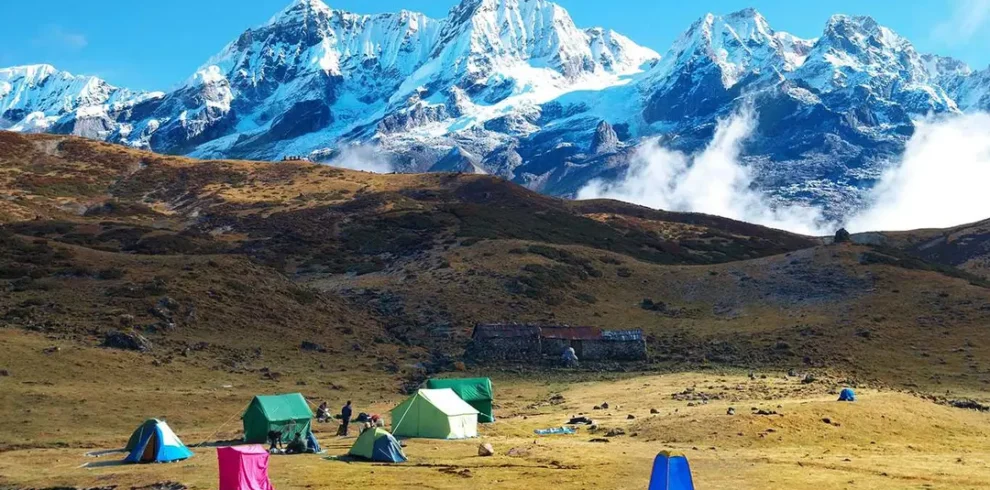
From Dzongla, the trail ascends steadily onto the moraine below the Cholatse Glacier, with the mountain’s west ridge and north face growing larger and more imposing with every step. Base camp is established on a flat moraine platform with a direct view up the route, and the first order of business on arrival is setting up tents, organizing climbing gear, and running a final equipment check with the climbing team. The altitude here has a tangible physical weight to it and most climbers notice that even simple camp tasks require deliberate, measured effort. The afternoon is for rest, hydration, and studying the route above through binoculars with your guide to identify landmarks and understand the sequence of technical sections.
This carry day establishes high camp and gives the team a first real experience of the lower glacier and the rock sections above. The route ascends steeply from base camp onto the glacier, requiring crampons and rope from early in the approach, and the terrain alternates between glaciated couloirs and exposed rocky ribs as you gain height. High camp is a narrow shelf on the upper mountain where two or three tents can be pitched, and the views from this position across the Khumbu Valley toward Pumori and the Nuptse wall are extraordinary in scale. Getting settled here early and resting through the afternoon is essential because the summit push begins in the very early hours of the following morning.
Summit day starts before midnight. The team moves by headlamp through the upper glacier, navigating crevasses and steep ice slopes on fixed ropes before reaching the summit ridge where the rock and ice become genuinely technical and exposure increases sharply on both sides. The summit of Cholatse at 6,440 meters offers a 360-degree view that places you at the center of the Khumbu massif, with Everest, Ama Dablam, Makalu, and the full length of the Ngozumpa Glacier visible in every direction on a clear morning. The descent requires full concentration and controlled movement on the technical sections, and the team returns to base camp by early afternoon. This is the most physically and mentally demanding day of the expedition.
This day is built into the schedule as both a recovery day and a contingency buffer for teams that were turned back by weather on summit day. Climbers who reached the summit use this time to rest, rehydrate, and begin processing the physical toll of the previous day. Those who need a second attempt can reassess conditions with the guide and, if the weather window is suitable, make another bid. The mountains in the Khumbu operate on their own schedule and having this buffer day built into the itinerary is one of the practical decisions that reflects field experience rather than optimistic planning.
Breaking down base camp is a focused and somewhat emotional process after several days on the mountain. The descent from the moraine to the valley trail passes through a landscape that now feels very different than it did on the way up, partly because you have changed and partly because the mountain behind you is no longer a destination but a memory. Lobuche sits at the junction of the Khumbu Glacier moraine and the Everest Base Camp trail, making it a surprisingly busy stop where you may encounter groups heading in both directions along the valley. The contrast between the quiet intensity of the upper mountain and the relative bustle of the trekking route is notable.
The long descent from Lobuche passes through Dingboche and Tengboche, both villages offering teahouses, clear views of Ama Dablam, and a gradual return to lower altitude where breathing becomes noticeably easier with each passing hour. Tengboche Monastery, which sits on a forested ridge at around 3,867 meters, is worth a short visit if time allows; the monastery courtyard is quiet in the afternoon and the mountain backdrop behind it is one of the most photographed scenes in the Khumbu. Reaching Namche after so many days above 4,500 meters feels like stepping back into a warmer and more oxygenated world, and most climbers notice improved sleep and appetite almost immediately.
The final day of trekking follows the familiar trail back down to Phakding and then climbs again through the forest before arriving at Lukla in the afternoon. The walking has a different quality on this day; the weight of the expedition has lifted, the conversations among team members are lighter, and the physical ease of lower altitude makes even the uphill sections feel manageable. Lukla celebrates returning expedition teams every day, and the small restaurants along the main street do a reasonable job of marking the occasion. Confirming your flight for the morning is the last practical task before an early night.
Mountain flights are weather-dependent and delays at Lukla are genuinely common, so keeping the morning relaxed and your expectations flexible is the right approach. When the flight does go, the 35-minute journey back over the foothills and into the Kathmandu Valley is a sharp visual compression of the two weeks you just spent on foot. Back in the city, the noise and warmth and variety of Thamel are a welcome contrast after weeks of high-altitude minimalism. Nepal Holiday Treks arranges a team dinner on this evening, which is a good opportunity to reflect on the expedition and thank the Sherpa and support staff who made it possible.
A free day in Kathmandu is rarely wasted. Pashupatinath Temple on the banks of the Bagmati River offers an immersive glimpse into Hindu cremation rituals and temple life that is unlike anything in the mountains. Patan Durbar Square in the neighboring city of Lalitpur has some of the finest medieval Newari architecture in the valley, with carved wooden temples and a museum worth spending a couple of hours in. For climbers who want to mark the expedition with a tangible memory, Thamel’s outdoor gear stores and thangka galleries provide plenty of options. The day is also practical for packing, washing gear, and preparing for the flight home.
A transfer to Tribhuvan International Airport concludes the expedition. Depending on your flight time, there may be a final morning for a last cup of Nepali milk tea or a walk through the quieter backstreets near the hotel. The expedition is complete.
Includes/Excludes
Cost Includes
- Airport pickup & drop
- Professional climbing guide
- climbing permit
- Trekking permits
- Accommodation during the trek
- Tented camp at Base Camp
- All meals during the trek
- Climbing training
- Safety equipment
- First aid support
- Support staff
Cost Excludes
- International airfare
- Personal climbing gear
- Travel insurance
- Personal expenses
- Tips for guide & porter
- Extra accommodation
- Emergency rescue
FAQs
Yes. Cholatse is a technically demanding peak requiring solid experience with crampons, ice axes, fixed ropes, and glacier travel. It is not suitable for first-time climbers or those without prior high-altitude mountaineering experience.
Spring (April to May) and autumn (October to November) are the two reliable climbing windows. Spring is generally preferred because the weather windows tend to be more stable, though both seasons carry inherent uncertainty at high altitude.
You need a strong aerobic base built over several months of consistent training including long hikes with a loaded pack, endurance cardio, and ideally some prior high-altitude experience above 5,000 meters. Showing up physically undertrained is one of the most common reasons climbers fail to summit.
Core equipment includes a double mountaineering boot, crampons, ice axe, helmet, harness, ascender, and a full layering system for temperatures that drop well below freezing above high camp. Nepal Holiday Treks provides a detailed gear list after booking, so you have time to source or rent anything missing before departure.